
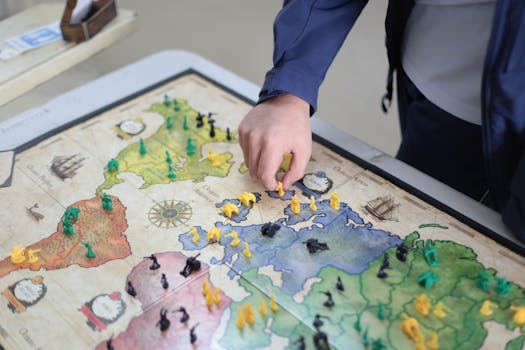
Tactical Strategy Worlds That Challenge Players With Precision and Depth
Bold choices, calculated moves, and creative risks give players a rush of anticipation you’ll rarely find elsewhere. The smart design of tactical strategy worlds transforms play into genuine problem-solving.
When you navigate tactical strategy worlds, your actions have meaning. The smallest decision ripples outward, making each session rewarding and distinct from the last.
If you’re eager to sharpen your strategic thinking and see what makes these game spaces so immersive, this article invites you to step inside and explore the mechanics that set them apart.
Expanding Vision: Adapting to Adaptive Strategy Environments
Reading this, you’ll gain tools for navigating evolving tactical strategy worlds by adopting flexible perspectives and shifting your approach according to the scenario’s needs.
Dynamic obstacles frequently force players to abandon original plans, quickly evaluating risks and seizing opportunity. Picture a chess match where the board itself changes every few turns.
Embracing Uncertainty and Shifting Ground
Consider a scenario mid-campaign when enemy reinforcements approach from a direction you previously cleared. You re-evaluate positioning, reallocate resources, and keep your strategy fluid.
Instead of panicking, you adopt “If X, then Y” flows. You learn to scout new threats every few turns, ensuring no blind spots emerge as the tactical strategy world morphs.
Players say things like, “Let’s pull back and establish a fallback zone.” This shift prevents tunnel vision and keeps the team prepared for evolving threats.
Risk-Reward Balancing in Dynamic Worlds
A reliable strategy relies on identifying which variables you can influence—and which will always be wild cards. In tactical strategy worlds, players constantly reassess this balance.
Suppose you see enemy artillery moving to flank your main squad. You quickly weigh the risk of advancing versus the benefit of entrenching and holding.
This means marking map zones for safety, reserving special skills, and communicating priorities: “Focus fire on the left—I’ll cover the ridge.” Such scripts reinforce clarity and coordination as rules shift.
| World Feature | Player Action | Challenge Type | Takeaway |
|---|---|---|---|
| Changing Terrain | Relocate units | Spatial Awareness | Regularly recheck map for optimal paths |
| Fog of War | Use scouts | Information Management | Prioritize vision—don’t overextend blindly |
| Adaptive AI | Adapt tactics | Reaction Speed | Vary moves to avoid predictability |
| Resource Scarcity | Budget supplies | Planning | Delay upgrades until critical moments |
| Player Alliances | Negotiate deals | Social Interaction | Review partners’ past moves before trusting |
Effective Unit Coordination in Deceptively Simple Systems
Clear coordination rules let you maximize every squad’s potential. To excel, use explicit role assignment and decisive communication with each round in tactical strategy worlds.
Basic games may hint at linear progress, but look beneath the surface and you’ll find rich cooperation dynamics and layered objectives that punish solo play.
Compartmentalizing Roles for Strategic Gain
Designate one player as scout, another as tank, and others as support. Each person knows the cue: “Hold point B as soon as I’m clear.” This structure prevents confusion.
Break complex battles into smaller group tasks. A main squad defends, while flankers disrupt. This division allows you to react faster and cover more ground confidently in tactical strategy worlds.
- Assign actions at the start to reduce scramble: Specific job assignments focus players and encourage accountability, letting everyone react faster in changing battle conditions.
- Set fallback signals before chaos erupts: Pre-planned cues like “Rally!” mean everyone knows precisely when to regroup, avoiding panic if plans unravel mid-match.
- Pair experienced and newer teammates: Blending skill levels lets less-experienced players learn on the fly, creating more resilient squads able to overcome diverse scenarios.
- Rotate leadership roles regularly: Empowering different players fosters adaptability in the group and uncovers innovative solutions through varied perspectives.
- Praise precise callouts: Rewarding clear and timely communication reinforces effective habits, ensuring your team reacts swiftly in rapidly evolving tactical strategy worlds.
Smart role allocation leads to smarter teamwork—giving you a real edge as complexity grows.
Sequencing Team Actions for Efficiency
Use concise round-by-round planning. For instance: “You breach at 0:30, I cover, everyone moves on my signal.” Preparing in advance trims wasted seconds in critical moments.
Map every teammate’s action for the next round. If one flanks while another distracts, outcomes become predictable and defenses remain coordinated in tactical strategy worlds.
- Set up synchronized planning huddles: These allow your team to lock in plans, minimizing improvisational errors during unpredictable in-game developments.
- Use simple checklists before big engagements: Pre-battle reminders guarantee vital skills don’t get skipped when stress spikes and attention splits.
- Automate backup plans: Agree on defaults (“If cut off, regroup at north exit”) so everyone has a fallback if voice channels go down.
- Clarify timing and trigger words: Assign phrases that prompt instant coordinated resets, empowering your squad to act as one under fire.
- Debrief calmly after each encounter: Honest discussion reveals gaps and encourages improvements, giving your group a concrete process to boost future performance.
Layering proactive sequencing onto role assignments brings reliability and resilience, crucial for tactical strategy worlds’ ever-morphing missions and enemy patterns.
Executing Multi-Stage Plans Under Unpredictable Threats
Crafting and adapting multi-stage plans sharpens situational awareness. In tactical strategy worlds, adapting mid-operation becomes second nature after repeated exposure to surprise obstacles.
One game night, you lay out a plan spanning three turns: breach the south gate, secure supplies, and retreat north. Suddenly, reinforcements cut off your escape—realigning instantly becomes essential.
Refining Response Tactics When Plans Shift
Teams skilled in tactical strategy worlds adopt an explicit “pause, regroup, re-plan” mantra. When objectives shift, say aloud, “We need to break and reassign right now.”
Move the group into a temporary safe zone—players can exchange information while protected, swapping roles as the new scenario demands. This flexibility strengthens problem-solving.
Assign at least two backup objectives—such as capturing a secondary resource point—making sure mission value remains even if original targets become unreachable mid-battle.
Integrating Quick Feedback Loops
After every encounter, collect input from everyone: “What worked?” “What caught us off-guard?” Integrate these lessons into the next mini-plan, strengthening your group’s competence.
Short feedback loops help individuals sharpen instincts and trust each other’s judgement, which is vital in the nuanced challenges posed by tactical strategy worlds.
After a narrow win or loss, write down one takeaway. This routine cements learning and helps you develop muscle memory for future unpredictability.
Conclusion: Consistent Growth Through Tactical Strategy Worlds
Every experience in tactical strategy worlds teaches you to approach problems with discipline, anticipation, and creativity, elevating your gameplay and deepening your skills.
Adjusting to shifting rules, maximizing team performance, and executing layered strategies all reinforce the real-world value of resilience and informed risk-taking.
Jump into tactical strategy worlds, test new systems, and build skills that transfer far beyond any board or digital field.